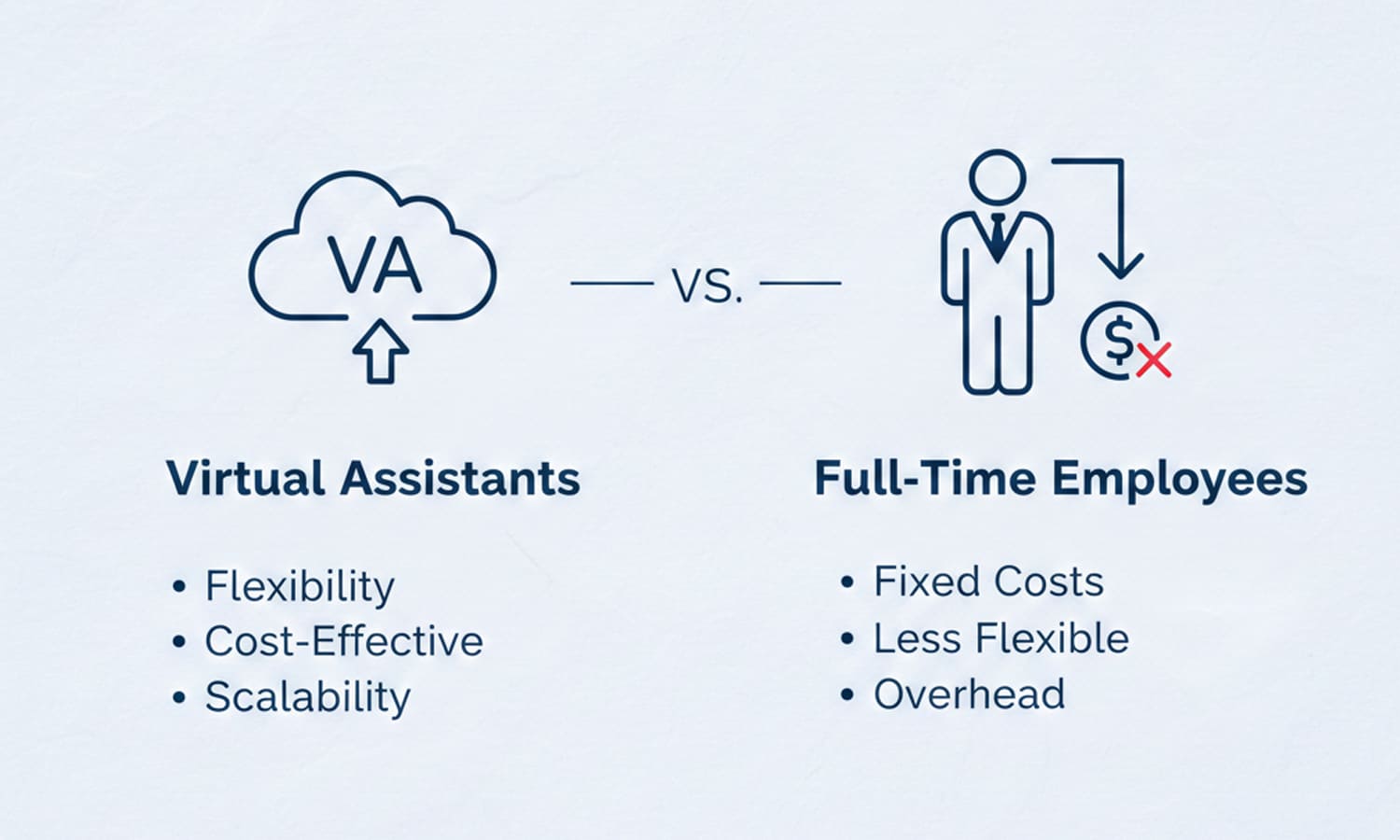
Virtual assistants vs. full-time employees
When you're running a business, you're constantly making judgment calls on where to spend money, where to cut back, and how to get the most out of every decision. One of the biggest calls you'll face is this: do you hire someone full-time, or do you bring in a virtual assistant? It's not a simple answer, but once you see the comparison laid out clearly, it becomes a lot easier to figure out what makes sense for where you are right now.
The Cost Question (And It's a Big One)
Let's start with the obvious: full-time employees are expensive. Not just their salary, but the benefits, payroll taxes, office space, equipment, onboarding time, and HR overhead that come with them. It adds up fast. Virtual assistants work differently. You pay for the hours they work or the tasks they complete, nothing more. No benefits. No desk. No equipment budget. For startups and small businesses especially, that kind of financial flexibility isn't just nice to have, it's often what keeps the lights on. If you're still in the early stages of figuring out what support you actually need, Why hire a VA is a good starting point before committing to anything.
Flexibility That Actually Means Something
Here's a scenario most business owners know too well: you hit a busy season, you need more hands, but hiring someone full-time for a temporary surge doesn't make financial sense. With a VA, you scale up. When things slow down, you scale back. No awkward conversations, no severance, no legal complications. Full-time employees are tied to contracts and labor laws, which exist for good reason, but do make agility harder. VAs give you the freedom to move fast, which in a competitive market, matters more than people realize.
You're No Longer Limited by Geography
When you hire locally, you get whoever's available locally. That might be great, or it might mean settling for someone who's almost right for the role. With a VA, you hire from anywhere in the world. That means you can find someone who's genuinely specialized in exactly what you need, whether that's bookkeeping, social media, customer support, or something more niche, and often at a better rate than you'd find locally. Here's how VAs scale your business.
Less Administrative Headache
Managing a full-time employee comes with a paper trail, like onboarding documents, tax filings, HR compliance, and performance reviews. It's necessary, but it takes real time and attention. VAs are independent contractors. That means you're largely freed from those obligations. You agree on scope, you communicate clearly, and you get the work done. It's a simpler relationship, which is part of why so many business owners find it refreshing.
Getting the Right Work Done by the Right People
One thing that often gets overlooked: it's inefficient to pay a full-time salary for tasks that don't require it. When you hire a VA specifically for scheduling, email management, or data entry, you're paying appropriately for the work and freeing yourself up to focus on the things only you can do. That's not a knock on full-time employees. It's just smart resource allocation.
What About Expertise?
Many VAs come with deep specializations, like bookkeeping, graphic design, content creation, and social media strategy. You can hire exactly the skill set you need for as long as you need it, without committing to a full-time role that may not stay busy enough to justify the cost. Hiring a full-time specialist only makes sense if the workload is consistent and significant. Otherwise, a VA gives you the expertise without the overhead.
The Honest Bottom Line
Full-time employees aren't going away, and for certain roles, they're absolutely the right call. But for a solopreneur, a startup, or any business that wants to stay nimble, a virtual assistant is often the smarter first move. It's lower risk. It's more flexible. And it forces you to get clear on what you actually need, which is a skill that pays off no matter how big your team eventually grows.